
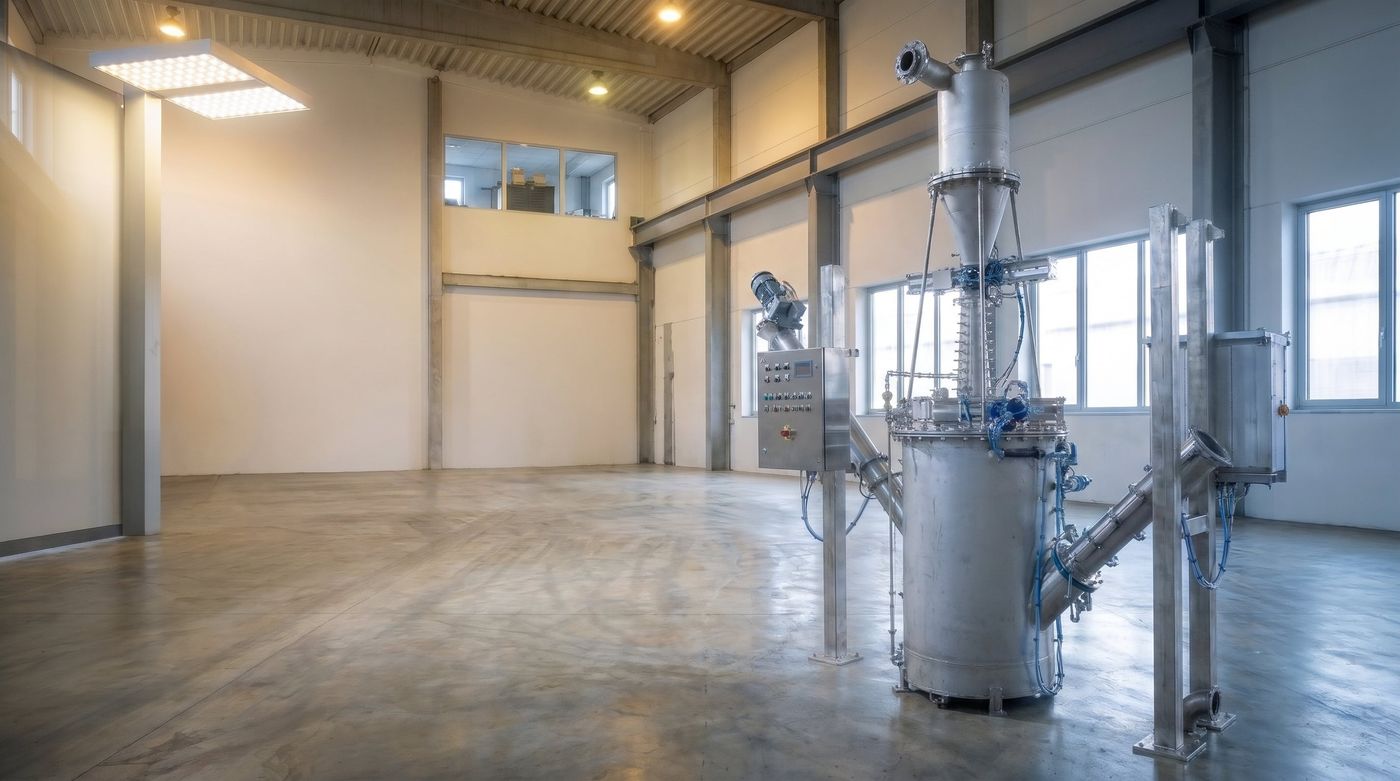
Contaminant removal for anaerobic digestion and MBT
Contaminants out.Before they settle.Rotaria CycloSort: hydrocyclone for grit and contaminant removal with integrated washer
Sand, glass, stones, bone fragments, metal and heavy plastics build up in your tanks and wear out pumps and pipework. CycloSort removes whatever is heavier than the liquid, washes it and discharges it dewatered. Compact enough for retrofits.
- around 40CycloSort units built
- 9 countriesfrom the UK to Ukraine and Canada
- 10 to 250 m³/hflow per unit size
- 3 in 1separation, washing, dewatering
- stainless steelcyclone, washer and screw
Grit costs money.
If you process food waste, biowaste or packaged out-of-date food, sand, glass, stones, bones, metal and plastics come in with the feedstock. A shredder or hammer mill makes the pieces smaller, not fewer. They travel through the whole plant.
Build-up
Sand, glass and other heavy solids settle in reception pits, digesters and digestate tanks and eat into working volume.
Wear
Pumps, mixers, valves and pipework wear faster and fail more often.
Downtime
Sooner or later the tank has to be emptied and cleaned: lost production, contractors and disposal costs.
How CycloSort works
Feed
A pump delivers the slurry tangentially into the hydrocyclone, where it starts to spin fast.
Separation
Centrifugal force throws everything heavier than the liquid against the cyclone wall: sand, glass, stones, bone fragments, metal, heavy plastics. They slide down into the underflow. The liquid leaves through the overflow, largely free of solids, and returns to the process.
Washing
The separated material drops by gravity into the upflow grit washer below the cyclone. Rising water strips the organic matter from the grit.
Discharge
A screw conveyor lifts the washed grit out of the washer, dewaters it on the way and drops it into a skip.
One skid, one unit
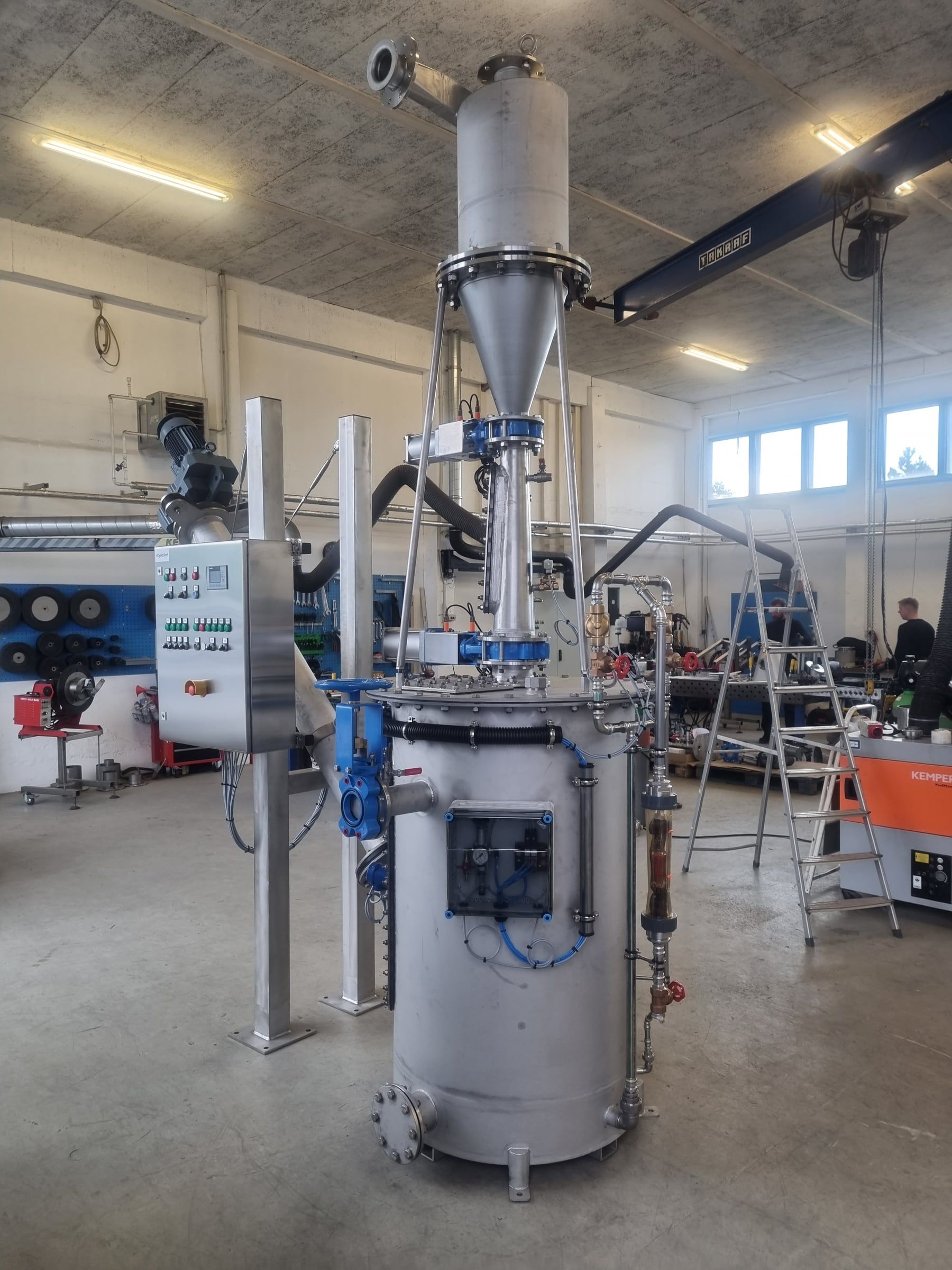
Cyclone, grit washer, discharge screw and controls come as a single unit. That saves space and installation time and fits into existing buildings.
- Tangential inlet
- Overflow: liquid back to the process
- Hydrocyclone
- Pneumatic valves at the underflow
- Upflow grit washer
- Discharge screw with geared motor
- Control panel
- Wash water with flow meter
Five reasons for CycloSort
High separation performance
The hydrocyclone separates by density. Heavy contaminants go to the underflow, the organic fraction stays in the process.
Grit washed and dewatered
Grit washing and dewatering are built in. You get a spadeable grit instead of an organic sludge.
Small footprint
Cyclone and washer are stacked. The complete unit sits on one frame.
Retrofit ready
CycloSort connects to an existing reception pit or tank. Its compact design fits into existing plants.
Proven in around 40 plants
In operation at AD and MBT plants in Germany, Denmark, the UK, Spain, Austria, Switzerland, Norway, Ukraine and Canada.
Around 40 units. In nine countries.
Designed and built on the German Baltic coast, running at AD and MBT plants from the UK to Ukraine and in Canada.
- Widnes, United Kingdom: AD plant
- Dagenham, United Kingdom: AD plant
- Doncaster, United Kingdom: AD plant
- Aylesbury, United Kingdom: AD plant
- Genthin, Germany: AD plant
- Lübeck, Germany: MBT plant
- Freienhufen, Germany: MBT plant
- Schwallungen, Germany: MBT plant
- Bebra, Germany: MBT plant
- Saarland (region), Germany: MBT plant
- Solrød, Denmark, 2 units: AD plant
- Horsens, Denmark: AD plant
- Sinding, Denmark: AD plant
- Nysted, Denmark: AD plant
- Copenhagen, Denmark: MBT plant
- Pamplona, Spain: AD plant
- Majorca, Spain, 2 units: MBT plant
- Barcelona, Spain: MBT plant
- Innsbruck, Austria: MBT plant
- Lustenau, Austria: MBT plant
- Zermatt, Switzerland: MBT plant
- Norway (region), Norway: MBT plant
- Ukraine (region), Ukraine: AD plant
Selection, not complete. For regions and countries the dot shows the approximate location only.
Technical data
| Process | Hydrocyclone with downstream upflow grit washer and discharge screw |
|---|---|
| Flow | 10 to 250 m³/h depending on size |
| Removed materials | All contaminants heavier than the liquid: sand, glass, stones, bone fragments, metal, heavy plastics |
| Feed | pumped |
| Material | Stainless steel |
| Controls | own control panel, connection to plant PLC |
Flow 10 to 250 m³/h: Rotaria data (brochure 2019).
Where CycloSort fits and where it does not
Suitable for
- AD plants processing food waste, biowaste and packaged food
- De-gritting digestate or digester contents in a side stream
- MBT: process water and slurries from wet processing
- Wastewater treatment as a supplement or alternative to a grit chamber
- Retrofits into existing plants
Not suitable for
- Films and plastics lighter than or close to the density of water. Use screening or a floatables removal for these.
- Very fine particles below the cut size
- Solids with a small density difference to the liquid
- Oil-water separation
- Stackable feedstock that cannot be pumped. It has to be pulped first.
Documents
Data sheet, dimensional drawing and tender specification are available on request.
Frequently asked questions
How do I get grit, glass and bone fragments out of my AD plant before they settle in the tanks?
With a hydrocyclone in the feed line or in a side stream. CycloSort separates heavy contaminants by centrifugal force, washes the grit and discharges it dewatered. The liquid with the organic fraction goes back to the process.
Does the feedstock have to be pumped into CycloSort?
Yes. A hydrocyclone needs a pressurised feed. The slurry is pumped from a reception pit or tank. We check during sizing whether your existing pump is sufficient.
Can CycloSort go straight after a hammer mill or shredder?
The shredded material must be pumpable. The usual way is to pulp it with process water or recirculate and then run it through the cyclone. Alternatively the contents of a mixing or reception pit are de-gritted in a loop. We choose the right layout with your data.
Does CycloSort remove plastics?
Yes, all plastic pieces heavier than the liquid, for example rigid plastics such as PET or PVC. Films and light plastics such as PE and PP float. They leave the cyclone with the liquid through the overflow. Screening or floatables removal is the right technology for those.
What flow rates can CycloSort handle?
10 to 250 m³/h depending on size. The right size depends on flow, dry solids and contaminant load.
How clean is the discharged grit?
The upflow washer strips off the organic matter and the screw dewaters the grit.
How much space does CycloSort need?
Cyclone, washer, screw and control panel sit on one common frame.
Can CycloSort replace a grit chamber?
At wastewater plants CycloSort supplements or replaces a conventional grit chamber. Whether it can fully replace yours depends on flow and grit load.
How much does a CycloSort cost?
The price depends on size, material and scope of supply. Send us your design data and you will receive a sizing and a quotation.
Do you deliver outside Germany?
Yes. CycloSort units run in Germany, Denmark, the UK, Spain, Austria, Switzerland, Norway, Ukraine and Canada.
What data do you need for sizing?
Plant type, medium, flow in m³/h, dry solids, type of contaminants, largest particle after shredding and the space available. Photos or a flow diagram help.
Main image optimised for presentation.
Fewer contaminants. Less wear.
Send us medium, flow and contaminants. We size CycloSort for your plant.
Worldwide delivery. Advice in German and English.